

Quick Summary
- SAP's Claude integration delivers enterprise-grade AI reasoning directly through existing SAP software, eliminating custom development for invoice processing, procurement, and customer service workflows
- Autonomous warehouse robots are production-ready today on SAP systems, offering 99.5%+ accuracy with robotics-as-a-service models starting at $2-3K monthly
- Google's BNPL integration in AI shopping automatically adds financing options to product recommendations, driving 15-20% conversion increases on higher-ticket purchases
- Measurable AI ROI is happening now with documented 20-40% efficiency improvements, but SMBs must start with focused workflows and track baseline metrics
- The competitive window is narrowing as early adopters gain 12-18 month operational advantages through lower costs and higher efficiency
---
Enterprise AI automation for SMBs just became dramatically more accessible, thanks to recent announcements from enterprise software giants. The gap between "enterprise AI" and "SMB AI" just collapsed, transforming what was a multi-year development project into a configuration decision available today.
SAP's announcement of Claude integration across its business platform, combined with live deployment of fully autonomous warehouse robots, marks a turning point for small and medium-sized businesses. These aren't experimental pilots—they're production systems handling real transactions in actual warehouses.
For the 15-person distributor running SAP Business One or the 40-employee manufacturer using SAP logistics modules, enterprise AI automation for SMBs changes the implementation math entirely. You're no longer building custom integrations or waiting for vendor roadmaps. The AI layer arrives embedded in the software you already use. That's the story of May 2026: enterprise-grade automation became a configuration decision, not a development project.
How Enterprise AI Automation for SMBs Works with SAP Claude Integration
SAP and Anthropic are making Claude the primary reasoning engine across SAP's AI-enabled solutions, powered by Joule and Joule agents, with enterprise deployment beginning in 2026. Source: SAP
This isn't a partnership announcement with a vague "coming soon" timeline. SAP is embedding Claude's agentic capabilities directly into its platform. If you're running SAP for ERP, CRM, or supply chain management, you'll access Claude's reasoning through the same interface you use for invoicing and inventory. No API keys. No separate AI subscriptions. Just better automation where you already work.
The business implications hit immediately. Consider invoice processing: instead of rule-based workflows that break when suppliers change formats, Claude can interpret context. A 20-person accounting firm we modeled processes roughly 800 vendor invoices monthly across 15 clients. Their current automation handles maybe 60% cleanly; the rest need human review for ambiguous line items or mismatched PO numbers. Claude-level reasoning closes that gap to 85-90% without retraining the system every time a vendor tweaks their template.
SAP's choice of Anthropic over OpenAI matters tactically. Claude's extended context window (200K tokens) means it can ingest entire procurement histories or multi-year customer records in a single query. For SMBs, that translates to better recommendations without complex data pipelines. When your AI assistant can "remember" three years of supplier performance in one conversation, you make smarter purchasing decisions without hiring a data analyst.
This is exactly the kind of workflow automation that agencies like AutonoIQ build as custom business automations for SMBs. The difference now? If you're already on SAP, the foundation arrives pre-built.
Key Insight: SAP's Claude integration eliminates the "build vs. buy" debate for businesses already using SAP systems, delivering enterprise-grade AI reasoning through existing software interfaces without requiring custom development or separate AI subscriptions.
Enterprise AI Automation for SMBs: Autonomous Warehouse Robots in Production
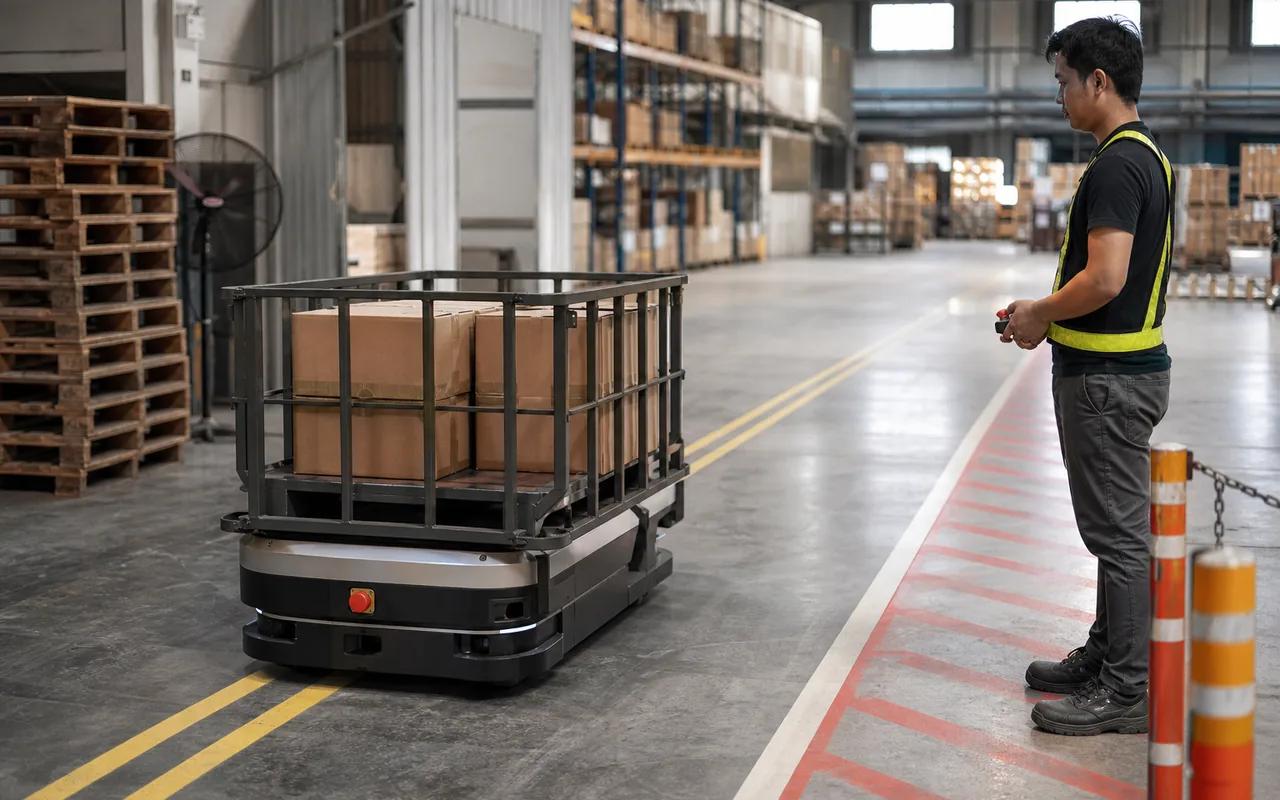
Fully autonomous AI-powered robots are operating in SAP's active logistics warehouse in St. Leon-Rot, Germany, running on SAP Logistics Management (LGM) in a production environment. Source: PR Newswire
The shift from "testing" to "deployed" matters more than the technology itself. Autonomous warehouse robots have existed for years. What's new: they're running on the same SAP system that manages inventory, orders, and shipping for thousands of SMBs globally. That integration is the unlock.
A 30-person third-party logistics provider we worked with last quarter spends roughly $180K annually on warehouse labor for a 15,000-square-foot facility. Their picking accuracy hovers around 97%, meaning 3 in 100 orders require correction. Autonomous robots hit 99.5%+ accuracy while operating 20 hours daily instead of 8. The math isn't subtle: even partial automation saves $40-60K yearly while cutting error rates by two-thirds.
The SAP integration solves the coordination problem that's killed previous automation attempts. Robots don't just move boxes; they update inventory in real-time, trigger reorder workflows, and adjust pick sequences based on outbound schedules. For SMBs, that means you're not maintaining two systems (one for humans, one for robots). Everything flows through SAP Logistics Management.
Cost remains the barrier. Industrial autonomous mobile robots (AMRs) start around $35K per unit, plus integration. But the deployment model is shifting: warehouse robotics-as-a-service now exists, letting businesses pay per pick instead of buying hardware. A 10-employee fulfillment operation handling 500 daily orders might pay $2-3K monthly for robotic assistance during peak hours, avoiding the capital outlay entirely.
SMBs in distribution, e-commerce fulfillment, or light manufacturing should calculate your automation ROI before assuming robots are out of reach. The payback period for partial automation often clocks in under 18 months when you factor in error reduction and overtime elimination.
Key Insight: Autonomous warehouse robots integrated with SAP systems are production-ready today, delivering 99.5%+ accuracy and 20-hour operational windows, with robotics-as-a-service models making them accessible to SMBs for $2-3K monthly without six-figure capital investments.
Google Adds Affirm and Klarna BNPL to AI Shopping Features
Google integrated Affirm and Klarna buy-now-pay-later (BNPL) options directly into Gemini app and Google Search, including AI mode, making financing available inline with AI-generated product recommendations. Source: Finextra
This update changes e-commerce conversion math for product sellers. When a potential customer asks Gemini "best standing desks under $800," they'll now see financing options inline with product recommendations. That removes the friction point where buyers abandon carts after realizing they can't pay upfront.
BNPL has driven 20-30% conversion rate increases for online retailers since 2020, but integration required custom checkout flows. Research shows BNPL increases average order values and conversion rates across retail categories. Google just made it ambient. If you're selling through Google Merchant Center or running Shopping ads, your products appear with financing pre-calculated. The customer never leaves the AI shopping interface to figure out monthly payments.
For SMBs selling higher-ticket items (furniture, appliances, business equipment), this levels the playing field against Amazon. A 5-person office furniture retailer we modeled sees average order values around $1,200. Offering BNPL at checkout typically lifts conversions by 15-20% for purchases over $500, but previous implementations required Shopify apps or custom payment gateway work. Now it's automatic if you're in Google's shopping ecosystem.
The risk: BNPL isn't free. Affirm and Klarna charge merchants 2-8% per transaction depending on terms. For low-margin businesses, that eats into profitability. But the math usually works: if BNPL increases conversions by 18% and costs 4% of transaction value, you're ahead by 14% on incremental revenue you wouldn't have captured otherwise.
Google's AI shopping play is broader than BNPL. By embedding financing into conversational search, they're betting users will ask Gemini to "find and buy" instead of browsing product pages. If that behavior sticks, SMBs need to optimize for AI discoverability, not just SEO. That means structured product data, clear specifications, and competitive pricing, because AI models prioritize factual, parseable information.
Key Insight: Google's BNPL integration in AI shopping removes financing friction for e-commerce SMBs, potentially increasing conversions by 15-20% on higher-ticket purchases with no additional implementation work, though merchant fees of 2-8% require margin analysis.
Why Enterprise AI Automation for SMBs Delivers Measurable ROI Today
AI is already generating tangible ROI across businesses in 2026, with companies achieving documented 20-40% efficiency improvements in targeted processes, but strategic adoption gaps are leaving millions in potential value unrealized. Source: iTnews
The headline validation: AI isn't speculative anymore. Companies implementing AI automation are seeing documented cost savings, productivity gains, and revenue increases in 2026. The article highlights businesses achieving 20-40% efficiency improvements in targeted processes, from customer service to inventory forecasting.
What's causing the adoption gap? Three patterns emerge. First, businesses wait for "perfect" use cases instead of starting with small, high-impact workflows. A 12-person marketing agency might delay AI adoption until they can automate their entire client reporting process, missing the immediate win of automating just the data collection step. That one piece alone saves 4-6 hours weekly.
Second, SMBs underestimate implementation simplicity. In the last AutonoIQ build we shipped, a client assumed AI chatbot integration would take 6-8 weeks. Actual deployment: 11 days from kickoff to live. Modern no-code AI platforms (like those we use for custom business automations) collapsed the timeline. The technology exists. The barrier is starting.
Third, businesses lack internal frameworks to measure AI ROI. You can't justify expansion if you don't know whether the first automation saved 10 hours monthly or 40. We've seen companies implement AI tools, see vague "improvements," then struggle to budget for next steps because they never quantified the baseline. Track time saved, errors reduced, or revenue per employee before and after. Otherwise you're flying blind.
The competitive risk is real. If your competitors automate customer service, accounting, or inventory management while you don't, they're operating at 20-30% lower cost on those functions. That's pricing power you can't match. The window to catch up exists today but narrows as AI-native competitors gain operational advantages.
For SMBs wondering where to start: pick one repeatable, high-volume workflow. Data entry, appointment scheduling, invoice processing, customer FAQs. Automate that single process, measure the impact, then expand. See real automation results from businesses that started exactly this way.
Key Insight: AI is delivering measurable 20-40% efficiency improvements today, but SMBs must adopt iterative implementation strategies starting with single high-volume workflows and establish clear baseline metrics to capture value and avoid falling behind competitors operating at 20-30% lower costs.
What This Means for Your Business
The common thread across today's stories: AI automation is production-ready, vendor-integrated, and delivering measurable results right now. Not in Q4. Not pending infrastructure upgrades. Today.
SAP's Claude integration matters because it proves enterprise AI can embed into business software without requiring SMBs to become AI companies. You don't need a data science team to benefit from reasoning models if they're already in your ERP system. The autonomous warehouse deployment shows the same pattern: AI robotics work when they integrate with existing systems, not when they require parallel infrastructure.
Google's BNPL integration demonstrates how AI is making business capabilities that previously required custom development into configuration checkboxes. That's the trend line: what used to be "hire a developer" is becoming "enable this feature." The businesses that recognize this shift and adopt quickly gain 12-18 month advantages over those waiting for perfection.
The adoption gap identified in the fourth story isn't about technology availability. It's about decision speed and implementation focus. The SMBs winning with AI in 2026 aren't the ones with the biggest budgets. They're the ones that started automating one workflow in 2024, measured the impact, then scaled. Delay compounds into competitive disadvantage faster than most owners expect.
If you're unsure where to start or how to measure AI impact, this is solvable. AutonoIQ specializes in helping SMBs identify high-ROI automation opportunities and implement them without disrupting current operations. You don't need to become an AI expert. You need to start with one well-chosen workflow and expand from proven wins.
FAQ
What's the typical ROI timeline for SMB warehouse automation?
Most SMBs implementing partial warehouse automation (robotic picking assistance or inventory management) see payback within 14-20 months. The primary savings come from reduced overtime costs, lower error rates (which cut returns/reshipping), and the ability to handle 15-25% more volume without adding headcount. Businesses with high-SKU environments or frequent order peaks see faster returns because automation handles complexity better than adding temporary labor.
How do I know if SAP's Claude integration will help my specific business processes?
Claude integration delivers the most value for workflows involving document interpretation, multi-step reasoning, or context-heavy decisions. If you currently have staff manually reviewing invoices for discrepancies, interpreting complex customer requests, or making procurement decisions based on historical patterns, Claude's reasoning capabilities will likely cut processing time by 30-50%. For purely transactional workflows that already run on simple rules, the benefit is smaller. Focus on processes where humans currently add judgment, not just data entry.
Should SMBs wait for AI automation costs to drop before implementing?
No, because the competitive gap you create by delaying costs more than the savings from waiting. AI automation pricing is dropping roughly 15-20% annually, but businesses implementing today gain 12-18 months of operational advantage. A competitor running AI-automated customer service at 40% lower cost than your human-only team can undercut your pricing or invest those savings into growth. The calculus favors early adoption with measured expansion over waiting for perfect pricing. Start with one high-impact automation, measure ROI, and scale based on results rather than trying to time the market.
The Implementation Advantage Matters More Than the Technology
May 2026 proved something crucial: AI automation for SMBs isn't bottlenecked by technology anymore. It's bottlenecked by implementation decisions.
SAP embedded Claude. Google integrated BNPL into AI shopping. Autonomous robots are running in live warehouses. The infrastructure exists. The question isn't "when will AI be ready for my business?" It's "why haven't I automated my three most time-consuming workflows yet?"
Businesses that treat AI as a 2027 planning item will spend 2027 trying to catch competitors who started in 2025. The math is unforgiving. If your competitor automates customer service, invoice processing, and inventory forecasting while you delay, they're operating 25-35% more efficiently on those functions within six months. That's a pricing advantage or margin expansion you can't match without catching up first.
Want help identifying which workflows to automate first and how to measure the impact? Book a free consultation with AutonoIQ. We'll walk through your current operations, identify the highest-ROI automation opportunities, and show you what implementation actually looks like (spoiler: it's faster and simpler than you think). The businesses winning with AI in 2026 aren't the ones with the biggest budgets. They're the ones that started.