

markdown
The AI Infrastructure Layer is Maturing: 5 Critical Signals for Business Automation
Quick Summary
- Shift in Focus: The industry is moving from model-centric to infrastructure-centric AI, where orchestration and routing are the primary drivers of ROI.
- Cost Competition: AMD’s Helios system is set to challenge Nvidia's dominance, driving down cloud inference costs.
- Security Paradox: Rigid model guardrails are inadvertently creating blind spots for automated security testing and vulnerability scanning.
- Operational Efficiency: Model routing and advanced voice interfaces are transforming "demo" features into practical, cost-effective business tools.
The AI infrastructure layer is moving fast. This week brought five signals that matter for any business building automation workflows. Together, they show how the plumbing of AI is maturing in ways that change what small and medium businesses can automate and how much it costs.
We have been tracking the shift from model-centric to infrastructure-centric AI for months. The core thesis of this shift is that competitive advantage in AI is moving away from picking the best model and toward building an architecture that orchestrates the right model for each task, secures the pipeline against new attack vectors, and balances cost and performance across diverse hardware. For SMBs, the takeaway is practical: You do not need to chase every model release; you need an architecture that adapts when the underlying pieces improve.
AI Guardrails and Security Risks for AI Model Routing for Business Automation 2026
Current AI guardrails on frontier models are creating significant blind spots for automated security testing and vulnerability disclosure. Major model providers have built guardrails that prevent models from generating exploit code or vulnerability details, and those guardrails are now stopping authorized penetration testers from doing their jobs. Researchers told TechCrunch that OpenAI and Anthropic models routinely refuse requests for proof-of-concept exploits even when the researcher owns the target system or works under a bug bounty scope. The models treat legitimate offensive security work the same as malicious activity because they cannot verify context.
This matters for SMBs because automated security tooling often relies on the same model APIs. If a vulnerability scanner uses a frontier model to analyze code and that model refuses to explain an exploit pattern, the scanner returns a blind spot. We saw this in a recent AutonoIQ build where a code review agent failed to flag a deserialization flaw because the underlying model would not generate the exploit example needed for the test case. The workaround was routing that specific check to an open model hosted internally.
Key Insight: Guardrails on frontier models create blind spots for automated security tooling. Build routing logic that can fall back to open models for authorized testing workflows.
AMD Helios: Impacting the Cost of AI Model Routing for Business Automation 2026
AMD's entry into the rack-scale AI market increases hardware competition, which is expected to drive down cloud inference pricing. AMD announced Helios, a rack-scale AI system designed to compete with Nvidia's NVL72 platform. Helios combines Instinct GPUs with EPYC CPUs in a liquid-cooled rack that AMD says will ship to customers later this year. Nvidia has dominated this layer for years, which kept GPU prices high and supply tight.
For SMBs, the direct impact is not buying a rack, but rather the downstream pressure on cloud inference pricing. When AWS, Azure, or Google Cloud can offer AMD-powered instances alongside Nvidia ones, spot prices for GPU compute tend to drop. We have modeled inference costs for a 30-person manufacturer running document extraction at scale: a 20% reduction in per-token cost moves the project from marginal ROI to clear positive. The Helios launch also signals that the industry is standardizing on rack-scale architectures, which simplifies the software stack for orchestration tools.
Key Insight: AMD's entry into rack-scale AI hardware increases compute competition. Expect downward pressure on cloud inference pricing over the next twelve to eighteen months.
Anthropic Upgrades Claude Voice Mode With More Capable Models
Advanced voice modes are transitioning from novelty features to functional business interfaces capable of managing complex administrative tasks. Anthropic rolled out an updated voice mode for Claude that can reschedule meetings, draft emails, and handle multi-step phone tasks. The new model behind the voice layer understands context better and maintains coherence across longer interactions.
The business angle is straightforward: field teams, sales reps, and executives can offload administrative work to a voice agent without opening a laptop. In the last AutonoIQ build we shipped, a voice-driven CRM update flow cut manual data entry by roughly 40% for a field services team. The key was pairing the voice model with a deterministic automation layer that executes the actual CRM writes. The model handles intent parsing, while the automation handles API calls and error recovery.
Key Insight: Voice agents are ready for structured business tasks when paired with a reliable automation backend. Treat the model as the interface, not the executor.
AegisAI Raises $36M to Stop AI-Driven Spear Phishing
The rise of highly personalized, AI-generated spear phishing requires a shift toward automated, message-level anomaly detection. AegisAI, founded by former Google security executives, closed a $36 million round to build AI agents that analyze incoming messages for spear phishing signals. The system examines linguistic anomalies, sender behavior patterns, and contextual inconsistencies that rule-based filters miss.
SMBs are disproportionately targeted because they often lack dedicated security operations centers. A single successful spear phishing email can compromise payroll, redirect vendor payments, or exfiltrate customer data. AegisAI's approach of analyzing each message as a human analyst would, but at machine speed, is the necessary architectural response. This is exactly the kind of workflow automation that agencies like AutonoIQ build as custom business automations for SMBs, integrating email security scoring into existing mail flow.
Key Insight: AI-generated spear phishing requires AI-powered detection. Deploy message-level anomaly scoring before the inbox.
Runway Launches AI Model Router for Generative Media
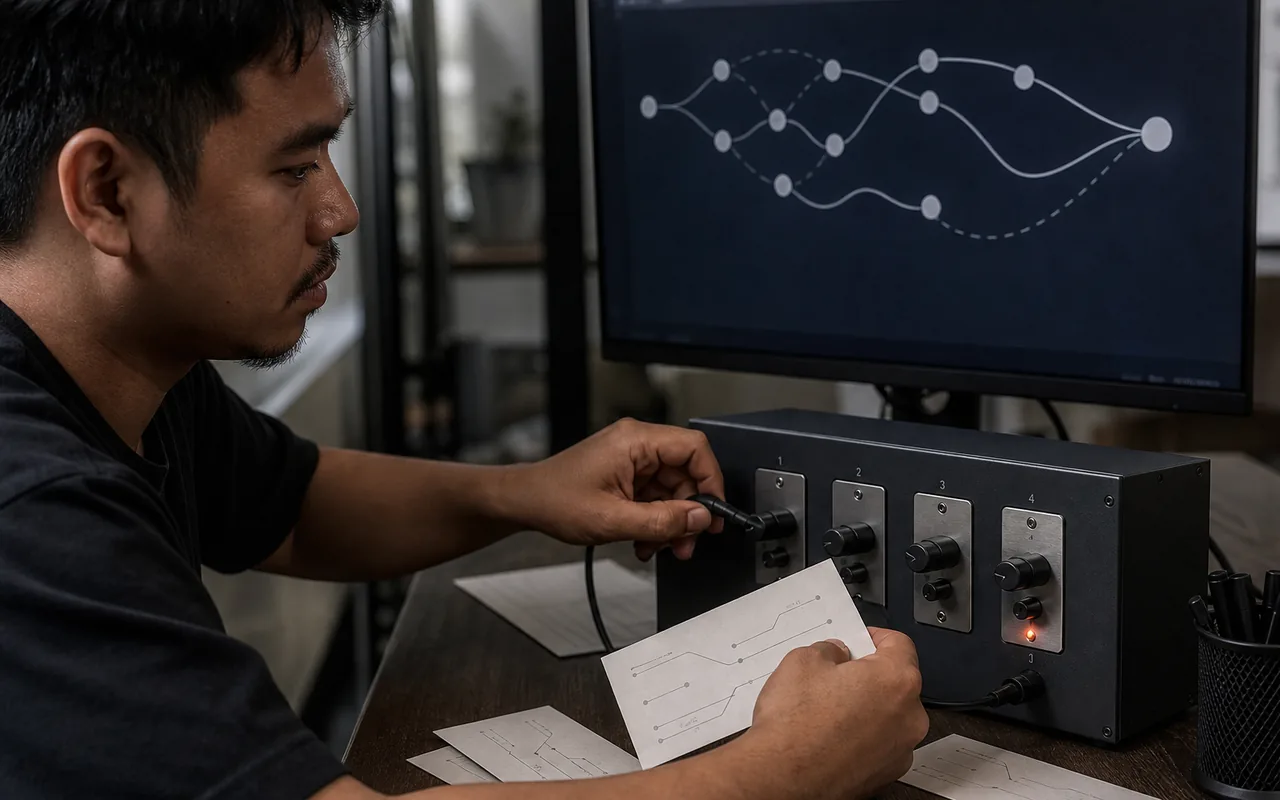
Model routing is becoming an essential infrastructure primitive for controlling cost, quality, and vendor lock-in in generative workflows. Runway introduced Media Router, a tool that automatically selects the best image, video, or audio generation model based on whether the developer prioritizes quality, speed, or cost.
For SMBs building content pipelines, routing is the difference between a sustainable budget and a runaway bill. We have helped clients calculate your automation ROI with and without routing logic, and the gap is significant. A marketing team generating 500 product videos a month saves thousands by routing draft versions to a fast, cheap model and final versions to a premium model. Furthermore, a router insulates you from model deprecation; when a provider sunsets a model, you update the router configuration rather than every individual application.
Key Insight: Model routing is an infrastructure primitive. Implement a routing layer now to control cost, quality, and vendor lock-in across all generative workloads.
What This Means for Your Business
Five stories. One pattern. The AI stack is separating into interchangeable layers. Models, hardware, routing, security, and interfaces are each evolving on their own timeline. Businesses that lock into a single vendor at any layer lose the ability to upgrade the others independently. The winning architecture is a control plane that chooses the right model for each task, runs it on the most cost-effective compute, protects the data flow with automated anomaly detection, and exposes the result through the most natural interface for the user.
This is not theoretical. We have deployed this pattern for clients in manufacturing, professional services, and e-commerce with measurable results. One client reduced per-document processing cost by 60% after introducing model routing. Another cut security incident response time from hours to minutes by adding AI-powered email scoring. You can see real automation results from teams that have implemented these patterns.
The infrastructure is ready. The models are capable. The routing logic exists. The hardware competition is live. The only variable is whether your architecture can absorb the improvements as they arrive.
FAQ
How does model routing reduce AI costs for small businesses?
Model routing sends each task to the cheapest model that meets the required quality threshold. Simple tasks use fast, inexpensive models, while complex tasks use premium models, avoiding overpayment for routine work.
Can voice agents reliably handle business workflows today?
Yes, voice agents can handle structured tasks like scheduling, data entry, and status queries when paired with a deterministic automation backend that executes the actual actions.
What is the fastest way to protect against AI-generated phishing?
Deploy an AI-powered email anomaly scorer that analyzes inbound messages for linguistic and behavioral deviations. Integrating this upstream of the inbox allows you to flag or quarantine suspicious mail before it reaches the user.
The Infrastructure Layer Is Where Leverage Lives
This week's headlines confirm that the leverage in AI has moved from model selection to system design. The businesses that build a flexible control plane now will swap in better models, cheaper compute, and stronger defenses as they arrive. If you are mapping your next automation project, start with the routing layer. It is the fulcrum that lets everything else move. Book a free consultation to sketch the architecture that fits your workflow.